GMO: What You Need to Know
Updated: 5 hours ago
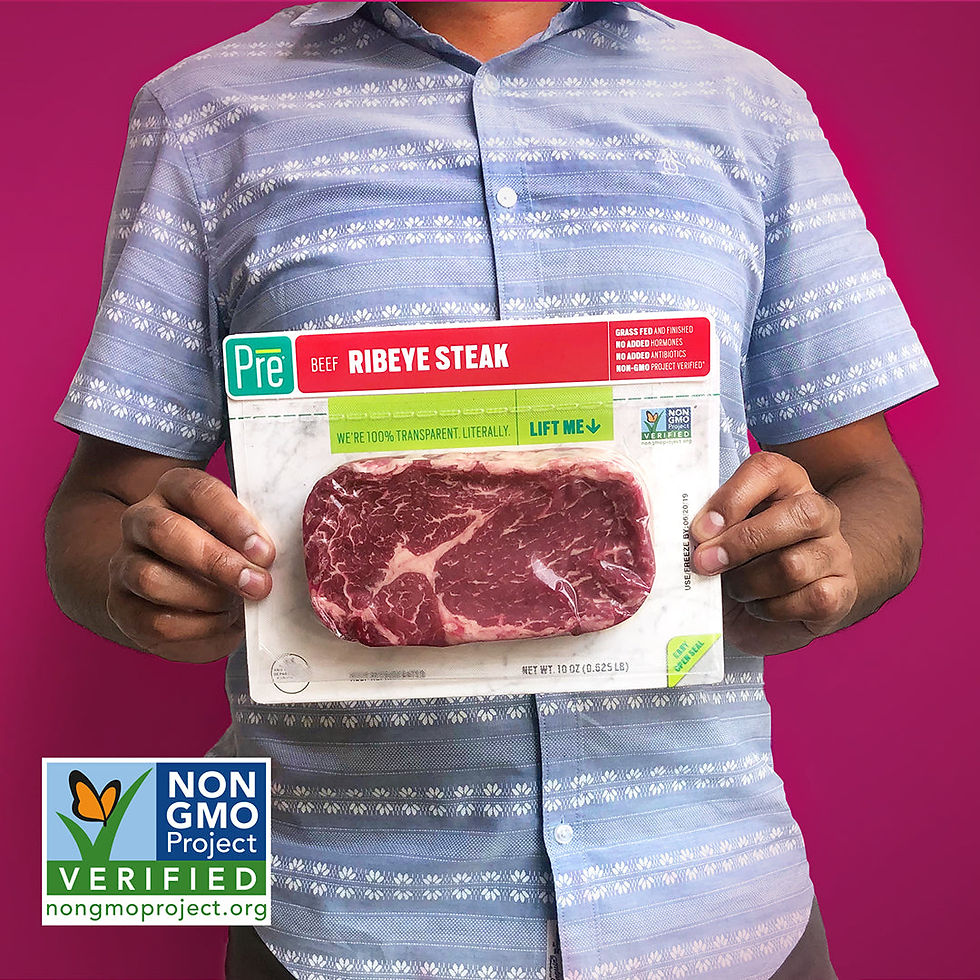
GMO: what you need to know. Pre beef is Non-GMO Project Verified, and the key to non-GMO beef is what the cattle eat. Here is the explanation from Pre's Chief Operating Officer at the time.

Insights from Patricia Willmot, then Chief Operating Officer of Pre Brands.
By now, you know that Pre is Non-GMO Project Verified. But do you really know what that means? And just as importantly, should you care?
As a discerning consumer, it is up to you to choose your food. You find out what you can and do your best to make an informed decision, but there is a lot of information, and sometimes misinformation, out there. As a company founded on 100% transparency, we have made it our mission to give you the information you need. For a deeper dive on GMOs, we went straight to Pat Willmot.
GMO: what you need to know about GMOs and meat
"GMO" stands for genetically modified organism, and refers to plants, animals, or other organisms whose genetic material has been changed in ways that do not occur naturally. The "non-GMO" claim means that the food is made without ingredients derived from genetically engineered organisms. For meat, poultry, dairy, and eggs, Non-GMO Project Verified means the animals were not fed a diet containing genetically engineered crops.
So GMOs are not added directly to beef. However, cattle may eat feed that comes from a genetically modified plant. All cattle begin their lives on a farm or ranch grazing on pasture or grass, none of which is a GMO. For Pre cattle, which are grass fed and grass finished, grass is their sole source of feed for their lifetime.
Many animals receive rations of grain, which may contain corn or soybeans, both of which have genetically modified varieties. Cattle sometimes also eat alfalfa hay, another crop with a genetically modified option. Beef from those animals typically cannot meet the non-GMO claim.
The majority of genetically engineered crop acres in North America are used for animal feed. According to the USDA's 2012 Census of Agriculture, 60% of all cropland is used for three crops: corn, soy, and forage. More than half of the corn and soy is used for animal feed, and almost all of it is GMO. According to the USDA Economic Research Service, 92% of U.S. corn harvested in 2016 was genetically engineered, as was 94% of the soy. Since genetically engineered alfalfa was introduced in 2010, forage acres are increasingly at risk, too. What all this points to is that animal feed is the key to a non-GMO future.
Why non-GMO feed is important
If you are wondering why it matters what an animal eats, consider this: almost all GMOs are engineered for one of two traits, or a combination of both. The first is herbicide tolerance, where a plant can be sprayed directly with a chemical herbicide like Roundup and survive. The second is insecticide production, where a plant produces the Bt (Bacillus thuringiensis) toxin, so an insect that eats any part of the plant will die. From a sustainability perspective, these traits may have consequences for the environment and for our food system.
Does Pre's sourcing impact GMO status?
Pre sources its beef from New Zealand and Australia, where cattle graze on pasture. Read more about why Pre sources from Australia and New Zealand.
How did Pre get Non-GMO Project Verified?
To claim Non-GMO Project Verified, Pre worked with a third-party certifying body and provided full documentation about how and where we source our beef. We believe third-party certifications are the best way to verify a claim, because they make sure the claim is unbiased, rigorous, and transparent. Only once the agency was satisfied with our documentation could we say our beef is Non-GMO Project Verified. Our grass fed and finished beef is raised on pastures in compliance with Non-GMO Project standards for avoidance of genetically engineered ingredients.
That is GMO: what you need to know. Wondering how this differs from organic? Read organic vs. non-GMO. Questions? Please ask! We are an open book. Send us a note at ReachUs@eatpre.com.
References: Total acres and cropland statistics from the 2012 Census of Agriculture, USDA National Agriculture Statistics Service. GMO percentages from the USDA Economic Research Service, 2016.
FAQ
What does 'non-GMO' mean for beef?
For meat, poultry, dairy, and eggs, Non-GMO Project Verified means the animals were not fed a diet containing genetically engineered crops.
Are GMOs added directly to beef?
No. But cattle may eat feed from genetically modified plants, like some corn, soy, and alfalfa, which is why feed is the key to a non-GMO future.
How did Pre get Non-GMO Project Verified?
Pre worked with a third-party certifying body and provided complete documentation about how and where we source our beef. Only when the agency was satisfied could we say Pre beef is Non-GMO Project Verified.
Where can I buy Pre 100% Grass-Fed & Finished Beef?
Pre Brands beef is a lean, High Protein, delicious way to keep dinner healthy. Use our store locator to find a store near you, browse all Pre products, or find us on Instacart.